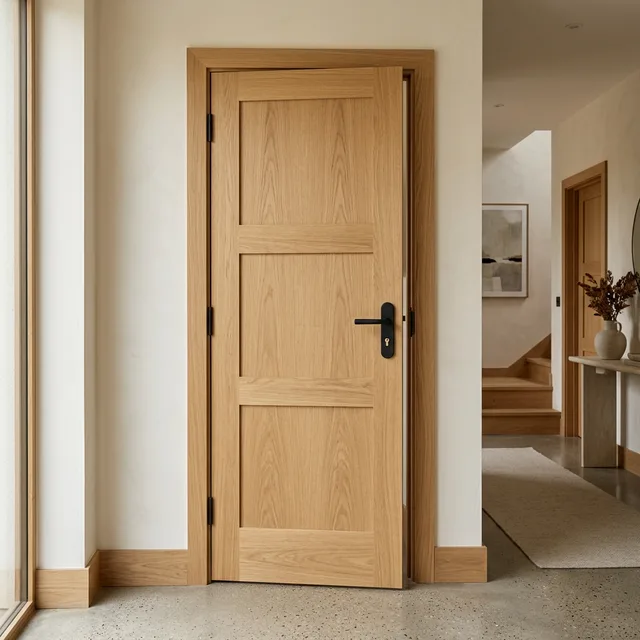

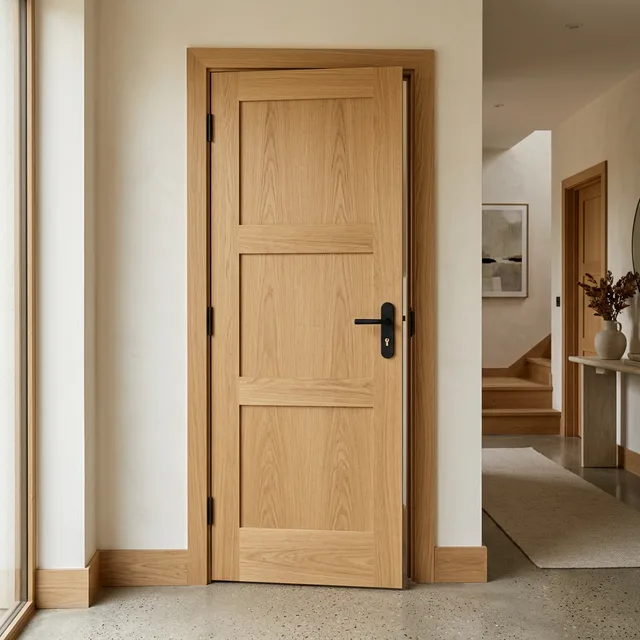
Internal Doors & Whole-House Refits
New internal doors hung into existing frames, matched handle sets throughout, and multi-door discounts when we refit the whole house in one visit.
Book Door Fitting →Knowing the parts makes it much easier to describe a problem or a job. Here is everything that makes up a hung internal door — from the frame and architrave through to the hinges, rails, stiles and latch.
The lining (head and two jambs) is fixed into the structural opening on packers so it sits plumb even when the wall isn't. The door stop is what the leaf closes against, and the architrave trims the joint between lining and plaster.
Vertical stiles (hanging side and lock side) and horizontal rails (top, lock/middle, bottom) form the leaf, with panels or a solid core between them. The bottom rail is deepest — that's where trimming allowance lives.
Three butt hinges carry the leaf (two on lightweight doors), the latch and spindle drive the handle, and the strike plate on the jamb receives the latch so the door closes with a clean click, not a slam.
A door that swings freely for decades comes down to method, not luck. This is the sequence our carpenters follow on every door.
Measure the frame in three places, check it for plumb and square, and let a new timber door sit in the room it's going into so it adjusts to the humidity before cutting.
Trim evenly from both stiles — never all from one side — and take height off the bottom rail, keeping within the manufacturer's trimming allowance. Plane a slight leading edge on the lock stile so it clears the frame as it closes.
Three hinges for solid or fire doors, recessed to the exact leaf thickness of the hinge — too shallow and the door binds, too deep and it won't close. Screws driven straight and fully home.
The door goes on and the gaps are checked all round — roughly a £1-coin thickness (2–3mm) at the sides and top, with clearance at the floor for the covering. The door should hold any position without swinging on its own.
Latch drilled at handle height, strike plate recessed so the door closes with a click and no rattle. All bare edges — including the top and bottom — sealed or painted so moisture can't twist the door later.
The mistakes below are what we're most often called out to put right. If you're tackling a door yourself, this list will save you a ruined leaf.
Guide figures for what door work typically costs across the UK, so you know roughly what to expect before you get quotes. Every job is different — we always confirm with a free fixed quote before any work starts.
Guide prices only, based on typical UK rates at the time of writing. Actual costs depend on the door, the condition of the frame and opening, ironmongery and access. Your written quote is the price you pay.
One door or a whole house of them — internal, fire-rated or external.
Looking for the rest of our woodwork? See our full carpentry & joinery services.
A straightforward swap into an existing, square frame typically takes 60–90 minutes per door, including trimming, hinge recesses, and fitting the latch and handle. Older properties with out-of-square frames, or fire doors with strips and closers, take longer.
Yes — most Cardiff and Caerphilly homes have frames that are no longer perfectly square. We scribe and plane the new door to follow the frame, keep an even gap all round, and re-set the stops so it closes cleanly. If a frame is beyond saving we fit a new lining.
Yes. Fire doors must be hung with fire-rated hinges, intumescent strips or fire-rated frames, controlled gaps, and self-closers where required. Where fire doors are needed — for example in flats, HMOs and some loft conversions — installation should follow the building regulations guidance that applies to your property.
Usually not. If the existing frame or lining is sound and reasonably square, a new door can be trimmed and hung into it. A new lining is only needed when the old one is rotten, badly damaged, or you want a different door size.
Yes — set-up, travel and tooling are shared across the visit, so the per-door rate drops when we hang several doors in one go. Whole-house refits are where the best value is; ask us to price the full set.
One sticking door or a whole house of new ones — get a free, fixed quote from our qualified carpenters.